

Let's Get Serious
Trump’s return to the White House challenges Mexico, but playing the victim or yielding to fear will lead us nowhere. Mexico must face this reality head-on, with resolve and seriousness.

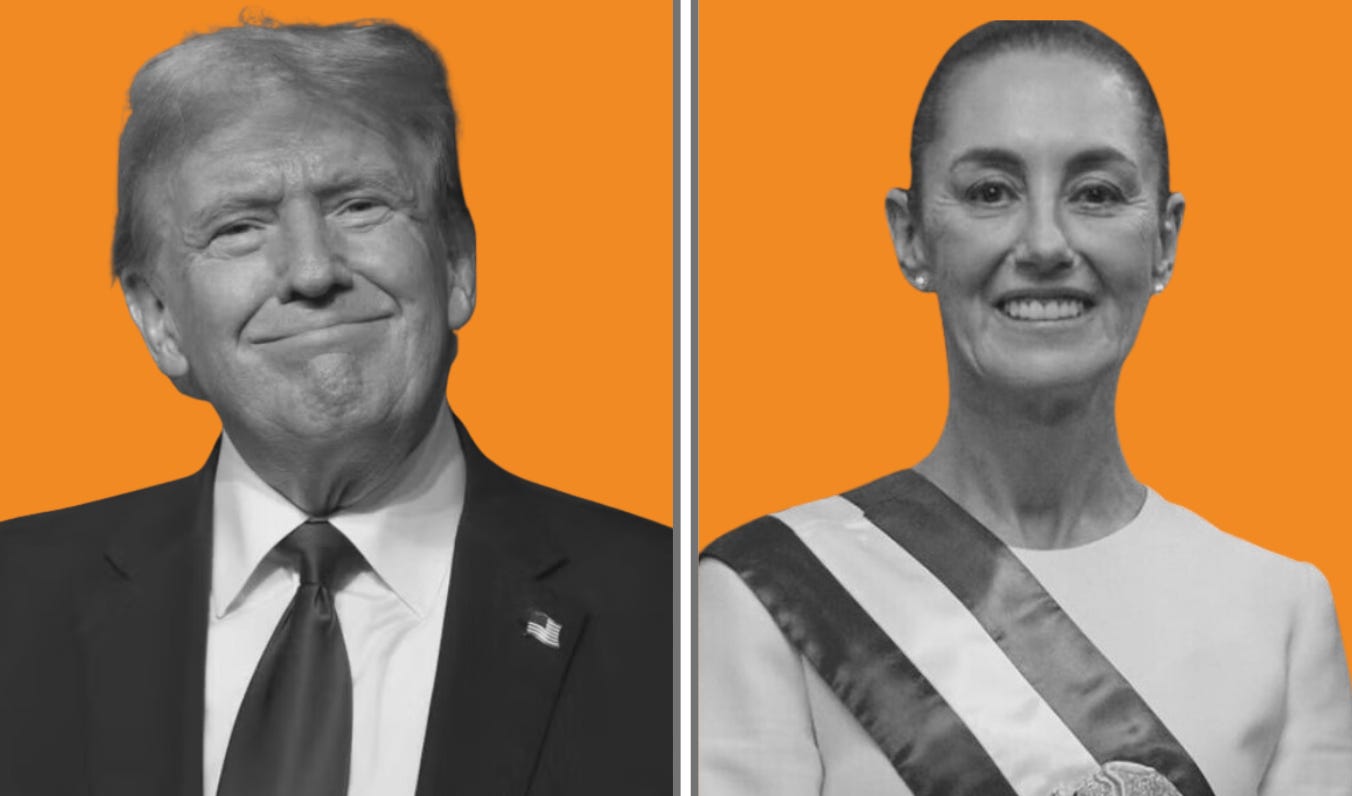
Diplomacy and foreign policy have never been Mexico's strong suits. Historically, given its size and relative capacities, Mexico has rarely been a significant player in global geopolitics. While there have been moments when international affairs took center stage, now should be one of those moments. It needs to be—because a second Trump presidency is all but certain, and Mexico remains one of the countries most vulnerable to his policies and whims.
Two fundamental characteristics define the bilateral relationship between Mexico and the United States. The first is the significant power asymmetry between the two nations: the U.S. holds a dominant position across all domains—military, economic, technological, and diplomatic. The second is the deep interdependence between them. A clear example is trade: Mexico became the United States' top trading partner, with exports surpassing $78bn in early 2024. Both countries are tightly bound by the United States-Mexico-Canada Agreement (USMCA), with strong value chain integration, particularly in sectors like automotive, electronics, and agribusiness.
These two characteristics have caused the bilateral relationship to oscillate between conflict and cooperation. Since the 1990s, Mexico has embraced trade liberalization and strategically aligned itself with North America, with NAFTA—and now USMCA—at the core of this approach. This was a prudent response to the end of the bipolar world and the rise of economic regionalism. Despite occasional setbacks, the strategy has proven effective for decades, fostering cooperation beyond trade in areas such as security and migration, and creating a mutually beneficial dynamic. However, this interdependence is inherently unequal: the United States holds significantly greater power than Mexico.
An effective foreign policy must begin with a clear understanding of the ongoing shifts in the international landscape and their implications for each country, as well as the constraints imposed by the foreign policies of others. In the case of Mexico, a second Trump presidency represents a fundamental challenge on two fronts. First, it marks a radical departure from the liberal international order in which Mexico is embedded—a flawed paradigm, yet one that has upheld values such as democracy, human rights, and free trade. Second, Trump's megalomania, compounded by his party's control of Congress and the Supreme Court, leaves little room for constructive dialogue and negotiation.
Unlike in 2016, today's Trump is no mystery. On the contrary, he is arguably one of the most scrutinized figures in recent history. Many of his former close aides, including Vice President Mike Pence and Chief of Staff John Kelly, have described him as unstable and unfit for office. Both Kelly and General Mark Milley even went so far as to label him a fascist. As for his policy agenda, it remains unmistakably clear: "Make America Great Again." The means? Mass deportations of undocumented migrants, weakening NATO, igniting a trade war with China, ignoring climate policy and human rights, opposing gun control, and promoting a federal government that prioritizes loyalty over competence.
Armed with far more information than in 2016, we are in a very different scenario. The uncertainty we face now is not about who Trump is but how far he is willing to go. Eight years ago, some of his supporters insisted we should "take him seriously, but not literally." Today, we know better—his confrontational rhetoric is not mere bluster but a true reflection of his worldview. Trump made genuine attempts to fulfill his campaign promises, from building sections of the border wall to withdrawing the United States from the Iran nuclear deal and the Paris Climate Agreement. A Trump 2.0 presidency seriously threatens American public life and global stability.
This new reality presents a monumental challenge for Claudia Sheinbaum's government. The potential for conflict is immense—not only because of Trump's repeated threats and criticism on issues like security, drug trafficking, and migration but also due to the significant power imbalance between the two countries. And let's be candid: the fact that Mexico's president is a woman matters too. Sheinbaum lacks the direct line of communication her predecessor had with Trump through his son-in-law. Instead, she faces an openly misogynistic figure whose disdain for women is well-documented. Throughout his career and especially during his presidential campaign, Trump's hostility has been blatant: he crudely implied that Vice President Kamala Harris advanced her career through sexual favors, labeled Nancy Pelosi as evil and deranged, and used violent language against Liz Cheney, a former Republican congresswoman, and critic, whom he dismissed as a coward.
I do not share President Sheinbaum's apparent calm nor the complacency of some of her cabinet members who have repeatedly insisted there is "nothing to worry about." Yet, I am also wary of catastrophizing. Both stances seem equally irresponsible and shortsighted. Given the intensity and significance of the bilateral relationship, it is clear that it will endure—but it will not be business as usual. The terms of engagement will change drastically. Mexico's room for maneuver will be limited, but it can—and must—still negotiate with Trump.
I believe Mexico should adopt a realistic and strategic approach that acknowledges the importance of personal relationships with the U.S. president and his inner circle, understands his priorities—especially regarding China—and embraces his transactional style. At the same time, Mexico must accept its relative weakness in the bilateral dynamic. The only way to reduce this asymmetry is for Mexico to strengthen itself internally by restoring peace and reigniting economic growth. However, this is where pessimism sets in, as recent developments, particularly the approval of MORENA's judicial reform, suggest that these conditions are unlikely to materialize anytime soon.
Given this outlook, Mexico's priority should be establishing open communication lines with President Trump and his team. Personal relationships are crucial in scenarios marked by high uncertainty, and building trust and rapport can be decisive. This was the strategy employed by former presidents Peña Nieto and López Obrador. For Sheinbaum, the primary interlocutors with the United States will be Economy Minister Marcelo Ebrard, Foreign Affairs Minister Juan Ramón de la Fuente, and the next Mexican Ambassador to Washington, who, as of this writing, has yet to be appointed.
Ebrard and De la Fuente have their supporters. Ebrard is seen favorably for his previous dealings with Trump, while De la Fuente is valued for his extensive career as a public official. However, Ebrard carries the baggage of conceding to Trump's tariff threats in 2019, when Mexico agreed to the controversial "Remain in Mexico" program, forcing migrants and asylum seekers to wait in Mexico while their claims were processed. As for De la Fuente, his experience as Mexico's Ambassador to the United Nations is often highlighted, but it has limited relevance to the day-to-day realities of navigating U.S. domestic politics.
Regarding the yet-to-be-named Mexican Ambassador to Washington, this position must be filled by someone with substantial experience—a seasoned politician or a career diplomat—who deeply understands U.S. domestic politics. The ideal candidate must be an effective communicator, a skilled negotiator, and, most importantly, someone who enjoys the full confidence of President Sheinbaum (not just of Ebrard or De la Fuente, but of Claudia herself). This is essential to ensure a strong and direct line of communication with the White House.
Beyond individual actors, we must grasp Trumpism's core priorities regarding Mexico: migration, security, and trade. Each of these issues could merit a separate essay, but for this piece, I want to focus on what I see as a major red flag in the near future: the review of the USMCA and Trump's renewed threat of tariffs.
I do not foresee the termination of the agreement. The interdependence between the two countries is deep, and the USMCA remains a highly beneficial trade instrument for all its members, including the United States. In a worst-case scenario, a lack of consensus could lead to annual reviews beginning in 2026. However, Trump's trade policy is notoriously unpredictable for Mexico, and tariffs will likely become his primary tool for exerting pressure to push his agenda on border issues.
The review process will likely feel like a renegotiation. It is foreseeable that the United States will seize this opportunity to rebalance the scales, especially after the approval of reforms under the so-called "Plan C," which directly contradict several USMCA provisions. This moment may also be used to reopen unresolved trade disputes, particularly in the energy sector, and to settle scores over the treatment of U.S. companies during López Obrador's presidency, such as the expropriation of Vulcan Materials' land shortly before the change in government.
In this context, having solid and experienced teams in international trade negotiations is critical—specifically, officials with technical expertise in areas such as automotive rules of origin, subsidy disputes, or anti-dumping practices. Unfortunately, these specialized teams were dismantled at the Ministry of Economy during the previous administration due to ideological differences and austerity measures.
Finally, we must address the relationship with China. This is not only a priority for Trump but also one of the few issues on which bipartisan consensus exists in the U.S. For Americans, it is a matter of national security, and Mexico would be wise to recognize this. The China issue will be central during the USMCA review, and Mexico has very limited room to maneuver on this front.
The challenge boils down to this: if, as President Sheinbaum has stated, the economies of Mexico and the United States are complementary, then strengthening the North American alliance is essential. Weakening it or succumbing to outdated Mexican nationalism and lingering anti-American sentiments within segments of MORENA—who fantasize about standing up to the "imperialist Yankees"—would be counterproductive.
A reinvigorated Trump is far from the ideal scenario for Mexico or the world, and the sooner this reality is taken seriously, the better prepared we will be to navigate the inevitable conflicts ahead. Mexico can no longer afford the recent indifference toward international affairs. Engaging strategically with Trump's administration must be a top priority for Sheinbaum's government; it is not a matter of choice but a necessity for economic and political survival.